
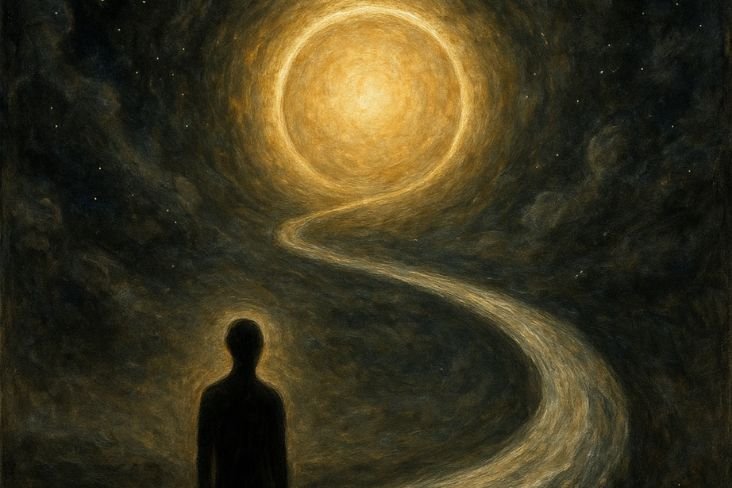
Does the universe have an edge, or does it stretch endlessly beyond what we can see?
What is our true place in this vast cosmos are we mere fleeting moments or part of a deeper journey that continues beyond life?
Do our actions and choices vanish with time or do good and evil carry meaning that transcends the physical world?
How do science, philosophy, and the major monotheistic religions Judaism, Christianity and Islam—approach these timeless questions about the universe and human existence?
As you read on, let these questions linger in your mind, opening the door to reflection on the mystery of existence and the purpose behind our lives.
A Scientific, Philosophical, and Religious Exploration
Humanity has always asked the same timeless question:
Does the universe—with all its galaxies, suns, and unseen realms—truly have an end?
And if everything eventually fades, what does that mean for us?
Are we temporary visitors living a few decades before vanishing forever, or are we part of a larger journey that continues beyond this world?
This article explores the issue through science, philosophy, and the three major monotheistic religions—Judaism, Christianity, and Islam—offering a complete view of human existence and cosmic destiny.
1. Scientific Views: Is the Universe Finite or Eternal?
Modern cosmology suggests three major scenarios for the fate of the universe:
1) The Big Freeze
The universe continues expanding until energy runs out, stars die, and a cold darkness prevails.
Keywords: heat death, cosmic expansion, entropy
2) The Big Crunch
Expansion reverses; everything collapses back into a single point—possibly followed by another Big Bang.
Keywords: cosmological collapse, universe cycle
3) The Big Rip
Dark energy accelerates expansion until even atoms are torn apart.
Keywords: dark energy, cosmic destruction
While science outlines physical endings, it cannot answer the deeper question: Is this the end of existence itself?
Here, philosophy—and religion—step in.
Philosophical Reflections: Are We Temporary or Transcendent?
Philosophers across cultures questioned whether human life is:
- a brief spark in a vast indifferent universe,
- or a bridge to a deeper dimension of existence.
Plato believed the soul pre-existed the body.
Ibn Sina (Avicenna) argued that consciousness points to an immaterial origin.
Descartes saw thought as proof of a self that transcends matter.
Quantum physicists like Werner Heisenberg hinted that reality has layers the mind cannot fully grasp.
Philosophy suggests a truth:
The human being feels internally that this world is not the final chapter.
Judaism, Christianity, and Islam: The Religious Perspective on Cosmic Destiny
The Abrahamic faiths share a profound view of the universe and human life:
Judaism: A World with Purpose and an Ending
Judaism teaches that:
- The universe is created and therefore finite.
- Human beings are placed in the world with a mission: to act justly, repair the world (Tikkun Olam), and walk in righteousness.
- History is moving toward a Messianic Age, a future of justice, resurrection, and divine judgment.
Judaism rejects the idea of meaningless existence; every action carries weight beyond death.
Christianity: Earthly Life as a Passage to Eternal Life
Christianity sees:
- The universe as created by God and destined for renewal.
- Human life as a temporary stage before the eternal world.
- The final events include the Second Coming, resurrection, and judgment.
Christian thought emphasizes that good and evil do not disappear.
Acts of compassion, faith, or cruelty echo into eternity.
Islam: A Finely Tuned Universe with a Clear Final Destiny
Islam teaches that:
- The universe is purposefully created and perfectly balanced.
- Human life is a test within a limited timeframe.
- The cosmos itself will end on the Day of Resurrection, followed by judgment and an eternal afterlife.
Islamic philosophy adds that the precision of the universe—what modern science calls fine-tuning—is evidence of intentional design.
In all three religions, the message is clear:
The universe has a beginning, a meaningful purpose, and an ultimate destination. So does the human being.
Does Good and Evil Fade Away in a Dying Universe?
From a purely physical standpoint, everything decays.
But philosophically and religiously, this decay does not erase the value of moral action.
- Science shows that actions reshape minds, societies, and collective memory.
- Philosophy argues that moral truths transcend the physical world.
- Judaism, Christianity, and Islam affirm that human deeds remain and are accounted for in an ultimate moral reality.
Thus, good and evil do not “vanish”—they continue beyond physical time.
Are We Just Passing Through This World?
Science reveals that every atom in our bodies was forged inside ancient stars.
Philosophy argues that consciousness points beyond material existence.
Religion teaches that human life is a chapter in a much larger story.
The convergence is striking:
Human existence is not accidental.
The universe is not random.
And our journey does not end here.
Whether through physics, metaphysics, or theology, the message is the same:
There is more to reality than what we see.
The universe may fade, but the story of existence continues.
A Universe with an Ending, but Humanity with a Destiny
Modern science predicts that the physical universe has an endpoint.
Philosophy suggests that human consciousness transcends matter.
Judaism, Christianity, and Islam teach that the universe is created with intention and will end with divine justice and resurrection.
The universe is finite.
But the meaning of human existence is not.
We are not here to vanish; we are here to continue.
Somewhere beyond this cosmic horizon lies a deeper world. another chapter where purpose, justice, and truth reach their fullest expression.